
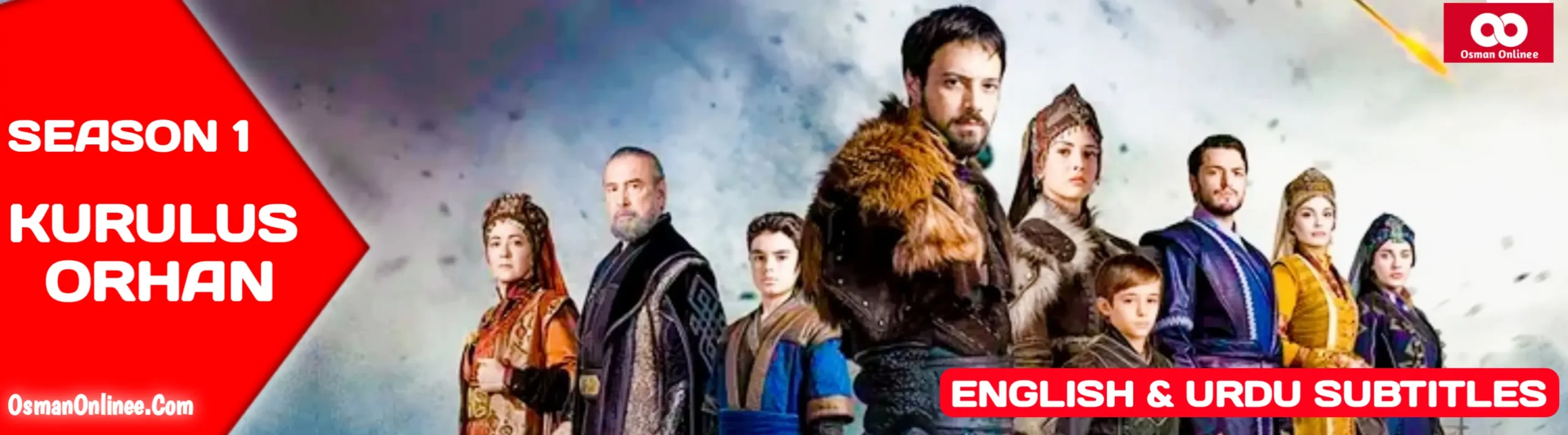
Kurulus Orhan Season 1 With English And Urdu Subtitles
From Vision to Responsibility: A Different Kind of Historical Story
Kurulus Orhan Season 1 does not begin with chaos or conquest; it begins with responsibility. This is a crucial difference that separates it from conventional historical narratives. Where many stories celebrate the moment power is seized, this season focuses on what happens after power is inherited. Orhan Bey stands at a historical crossroads where courage alone is no longer enough. The dream has already been ignited; now it must be protected, shaped, and transformed into something permanent.
The narrative deliberately slows its pace to reflect this transition. Instead of glorifying constant conflict, the season emphasizes decision-making, restraint, and moral pressure. Leadership here is not romanticized. It is shown as isolating, demanding, and deeply consequential. Every choice creates ripples that affect not only warriors and rulers, but families, alliances, and the social fabric itself.
This approach places Kurulus Orhan Season 1 closer to real historical experience than myth. It reminds us that the survival of a state depends less on dramatic victories and more on the invisible discipline that follows them.
Anatolia in Transition: The Historical Pressure of an Unstable World
The world of Kurulus Orhan Season 1 is shaped by instability. Anatolia is not a unified land but a contested space where authority changes hands frequently and legitimacy is constantly questioned. Byzantine influence has weakened but not vanished, religious military orders operate through covert structures, and Turkic beyliks struggle to secure their existence rather than expand their dominance.
This fragmented political landscape creates a constant atmosphere of uncertainty. Power must be defended not only against enemies, but against betrayal, shifting alliances, and internal dissent. The series captures this tension through quiet moments as much as open confrontation. Decisions are rarely simple, and hesitation can be interpreted as vulnerability.
Historically, this period marks the transformation from tribal leadership to early state formation. The season reflects this reality by emphasizing systems over personalities. Authority is no longer personal alone; it must become institutional. This pressure defines every character’s behavior and gives the season its grounded, realistic tone.
Orhan Bey as a Transitional Leader: From Heir to Institutional Architect
Orhan Bey is written as a transitional figure — neither founder nor conqueror, but something far more complex. His leadership emerges in the shadow of an existing vision, which limits his freedom but sharpens his responsibility. Unlike Osman Bey, who could act decisively to ignite resistance, Orhan must consider continuity, stability, and long-term consequences.
Throughout the season, Orhan repeatedly faces moments where emotional reaction would be easier than measured response. Yet he resists impulsive dominance. This restraint is not uncertainty; it is historical awareness. Orhan understands that uncontrolled power invites chaos, while controlled authority creates acceptance. His choices reflect a growing commitment to legitimacy rather than fear.
Symbolically, Orhan Bey represents the shift from loyalty-based leadership to rule-based governance. His actions hint at the emergence of order, predictability, and accountability — essential elements for any structure that wishes to endure beyond a single generation.
“The true test of leadership is not how power is taken, but how it is restrained.”
This philosophical core defines his journey throughout Season 1.
Kurulus Orhan Season 1 With English Subtitles
Kurulus Orhan Season 1 With Urdu Subtitles
Osman Bey’s Legacy: Ideology Beyond Presence
Although Osman Bey is no longer the central figure, his influence shapes the entire narrative. His legacy functions as a moral framework rather than direct authority. Orhan does not merely inherit land or followers; he inherits an idea rooted in justice, unity, and faith-driven purpose.
The season explores the tension between honoring this legacy and adapting it to new realities. Blind imitation would lead to stagnation, while total departure would betray the foundation itself. Orhan’s struggle lies in balancing continuity with evolution — a challenge faced by every historical successor.
Osman Bey’s presence reminds the audience that ideals must outlive individuals. His vision is not frozen in time; it demands reinterpretation. This dynamic deepens the emotional and philosophical weight of the story, showing how history progresses not by repetition, but by responsible transformation.
Nilüfer Hatun: Emotional Intelligence as Political Strength
Nilüfer Hatun embodies a different form of power — one that operates quietly but decisively. Her role extends beyond personal connection, representing cultural adaptation and emotional intelligence. In a world driven by suspicion and rivalry, she introduces patience, understanding, and perspective.
Rather than escalating conflict, Nilüfer absorbs tension and redirects it. Her influence is subtle but stabilizing, often preventing emotional decisions from turning destructive. This quality makes her essential to the ecosystem of leadership surrounding Orhan Bey.
Historically, figures like Nilüfer Hatun symbolize the unseen architecture of governance. States are not sustained by commanders alone; they endure through individuals who soften rigid structures and humanize authority. Her presence reinforces the idea that empathy is not weakness, but strategy.
Princess Asporça: Pride, Loss, and the Trauma of Decline
Princess Asporça is one of the most psychologically layered characters of the season. She represents a declining order struggling to accept historical inevitability. Her resistance is rooted not in cruelty, but in loss — loss of status, certainty, and identity.
Asporça’s pride functions as a shield against humiliation. The season avoids reducing her to a simple antagonist, instead portraying her as a person trapped between what once was and what can no longer be preserved. This emotional realism adds depth to the narrative and reflects how historical transitions often wound individuals long before systems collapse.
Through Asporça, the story explores how power structures do not disappear quietly. They resist, fracture, and leave scars behind. Her character reminds the audience that change, even when necessary, is rarely painless.
Hector and the Collapse of Illegitimate Authority
Hector represents authority under siege — not from overwhelming enemies, but from internal decay. His leadership relies increasingly on secrecy, coercion, and fear. This shift reflects a historical pattern: when legitimacy weakens, rulers compensate with control.
Rather than presenting Hector as a purely external threat, the season frames him as a symptom of a failing system. His decisions grow harsher as confidence erodes, revealing how authority collapses from within before it falls openly.
This portrayal adds political realism to the series. It suggests that power sustained through fear alone is inherently unstable. Hector’s arc serves as a cautionary study of leadership divorced from moral acceptance.
Flavius and Fatma Hatun: Conscience Versus Obligation
The relationship between Flavius and Fatma Hatun introduces a deeply human conflict into the political narrative. Flavius is torn between obedience and conscience, forced to navigate loyalty within a system that demands moral compromise.
Fatma Hatun represents vulnerability and sincerity — qualities that become dangerous in a world governed by suspicion. Through her, the series illustrates how ordinary lives are reshaped by power struggles beyond their control.
This storyline emphasizes that historical change is not experienced only by leaders. It affects individuals whose personal choices become battlegrounds for larger ideological conflicts.
Halime and Dursun: Maturity Through Displacement
Halime and Dursun’s journey reflects the theme of growth through hardship. Removed from protection and familiarity, they confront vulnerability and emotional truth. But their story reinforces the idea that strength is often forged outside centers of power.
This subplot grounds the season emotionally, reminding the audience that resilience is not exclusive to rulers. History is shaped equally by those who endure its consequences.
Core Themes and Symbolic Structure of Season 1
Several themes consistently shape the narrative:
- Justice as Restraint, not vengeance
- Legitimacy over Fear as the basis of authority
- Faith as Moral Guidance, not domination
- Change as Historical Necessity, not betrayal
These themes are embedded in character choices rather than delivered through exposition, giving the season its intellectual depth.
Season 1 as Foundation Rather Than Climax
Season 1 deliberately avoids finality. Its purpose is preparation. The ideological groundwork laid here explains why future developments become possible. Decisions made quietly echo forward, shaping alliances, governance, and expansion.
History does not accelerate without discipline. This season captures that truth with patience.
Why This Page Exists as a Central Reference
This page serves as a comprehensive reference for Kurulus Orhan Season 1, presenting the season as a unified historical and thematic structure. It provides context, continuity, and interpretive depth that supports further exploration through language-specific paths.
Key Takeaways
- Season 1 focuses on responsibility, not conquest
- Orhan Bey symbolizes institutional leadership
- Characters represent historical forces, not stereotypes
- Power is examined through legitimacy and morality
- The season prepares, rather than concludes, history
Conclusion: The Burden of Continuity
Kurulus Orhan Season 1 is a story about becoming worthy of inheritance. It argues that power achieved without discipline collapses, while power carried with restraint endures. Through Orhan Bey’s journey, but the season reveals a historical truth often ignored: the hardest part of leadership begins after victory.