
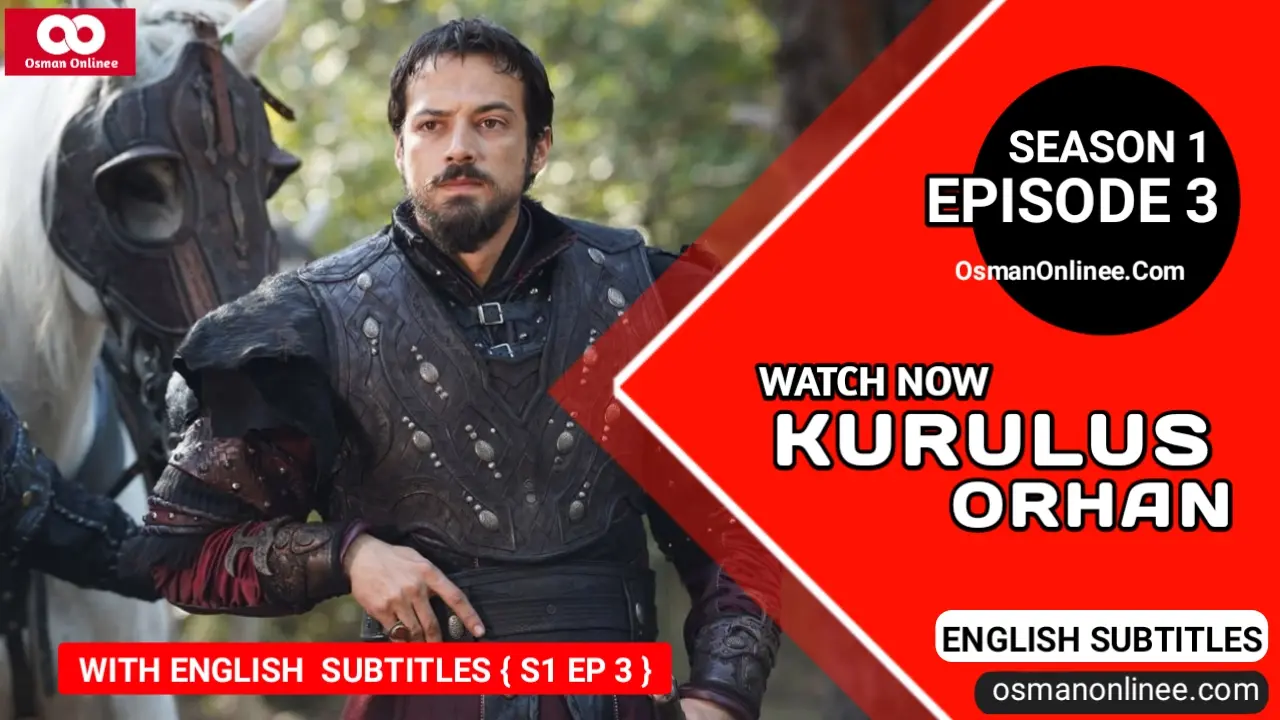
Kurulus Orhan Season 1 Episode 3 With English Subtitles
When Authority Is Questioned: The Episode Where Orhan Bey Steps Forward
Kurulus Orhan Season 1 Episode 3 is the first episode where the narrative clearly shifts its weight onto Orhan Bey’s shoulders. Until this point, Orhan has existed in the shadow of Osman Bey’s authority, but Episode 3 deliberately removes that protection. Osman Bey’s illness creates not only political uncertainty but emotional instability within the tribe, forcing Orhan to act without the comfort of unquestioned legitimacy. This episode carefully shows that leadership does not begin with power; it begins with pressure.
The famous line — “Görelim bakalım, el mi yaman, bey mi yaman!” — is not used as a dramatic slogan but as a philosophical challenge. It questions whether collective noise can override moral clarity, and whether a true bey must sometimes stand alone against both enemies and allies. Episode 3 revolves around this dilemma, making Orhan’s internal struggle as important as the external threat around Bursa.
Political Storm Around Bursa: Strategy Versus Impulse
The alliance formed by the Byzantine forces, the Ilkhanids, and rival Türkmen Beylikleri around Bursa is presented as dangerous but deeply unstable. Episode 3 makes it clear that this unity is not born out of trust, but out of fear of Ottoman expansion. Historically, such alliances rarely lasted long, and the episode subtly reflects this by showing how desperation, rather than discipline, drives the enemy’s actions.
Orhan Bey’s suggestion of pursuing peace shocks the council because it contradicts traditional expectations of warrior leadership. However, this proposal is rooted in strategy, not hesitation. Orhan understands that fighting on multiple fronts while Osman Bey is ill could fracture internal unity. His position reflects early Ottoman pragmatism, where restraint and timing were often more decisive than immediate confrontation.
The toy scene becomes a critical turning point. As voices rise in favor of immediate war, Orhan Bey recognizes a pattern of emotional agreement rather than strategic reasoning. His anger is not arrogance; it is frustration at seeing collective wisdom fail. When he strikes the table, it symbolizes a rejection of blind consensus and establishes him as a leader willing to carry responsibility alone.
Osman Bey’s Absence and the Weight of Inheritance
Osman Bey’s illness functions as the emotional core of Episode 3. His physical absence exposes fractures within the tribe that authority had previously suppressed. Without Osman’s commanding presence, unresolved ambitions and ideological differences surface openly. The episode suggests that true leadership is not tested when a strong ruler is present, but when his influence is temporarily removed.
For Orhan Bey, this absence creates an internal conflict. He must protect the beylik while avoiding the appearance of overstepping his father’s authority. This tension defines his actions throughout the episode. Episode 3 portrays Orhan not as a flawless hero, but as a son struggling to honor legacy while responding to urgent realities. This balance between obedience and initiative becomes central to his character arc.
The Women’s Sphere: Power That Moves Quietly
Episode 3 gives significant narrative space to the hatuns, emphasizing that political influence within the beylik does not belong exclusively to the battlefield. Malhun Hatun’s fear is rooted in history; internal division among heirs has destroyed many Turkic dynasties. Her concern is not about which son rules, but about the cost of rivalry within the family.
Didar Hatun operates as a destabilizing force. Her words to Gonca Hatun are carefully chosen to inflame doubt and resentment. By suggesting that Malhun Hatun favors Orhan, Didar turns personal insecurity into political tension. The episode highlights a historical truth: many power struggles begin with whispered accusations rather than open rebellion.
Gonca Hatun’s belief that Alaeddin is the rightful heir places her at a moral crossroads. Episode 3 does not resolve her conflict, but clearly positions her as a character whose choices will shape future divisions. Through these women, the episode shows how influence often travels silently but strikes deeply.
Enemy Lines: Calculation Behind the Chaos
On the opposing side, Episode 3 presents Temurtaş, Saroz, and Flavius as a coordinated but ideologically fractured group. Each represents a different form of hostility toward the Kayı tribe. Temurtaş embodies raw aggression, Saroz calculated strategy, and Flavius personal vengeance driven by past losses. Their unity is tactical, not emotional.
The decision to target the caravan returning from İnegöl is particularly significant. In medieval societies, caravans were lifelines that sustained both economy and morale. Attacking one was an act of psychological warfare. By placing Fatma Hatun at the center of this ambush, the episode elevates the threat from military pressure to personal provocation, ensuring that the conflict will escalate beyond strategy.
Fatma Hatun: Courage Beyond the Battlefield
Fatma Hatun’s role in Episode 3 challenges conventional portrayals of women as passive victims of conflict. Although she becomes a target, the narrative does not frame her presence as weakness. Instead, her capture is used by the enemies as leverage, revealing their reliance on intimidation rather than strength.
Flavius’ demand to take Fatma Hatun alive exposes his obsession with revenge over victory. His hatred blinds him to strategic consequences, a contrast deliberately drawn against Orhan Bey’s controlled decision-making. Through Fatma Hatun, the episode reinforces a key theme: enemies driven by personal vendettas often underestimate those fighting for a larger purpose.
Orhan Bey vs Flavius: A Clash of Intentions
Orhan Bey’s decision to confront Flavius is not motivated by pride or impulse. Episode 3 makes it clear that allowing enemies to dictate terms through hostage-taking would signal weakness and invite further aggression. By choosing confrontation, Orhan establishes a boundary that cannot be crossed without consequence.
The clash between Orhan and Flavius is framed less as a duel of strength and more as a confrontation of intent. For Orhan, the sword represents responsibility and protection. For Flavius, it represents vengeance. When steel meets steel, the episode suggests that moral clarity ultimately outweighs blind hatred.
Themes and Symbolism
- Leadership vs Popularity: True leaders resist applause when it leads to disaster.
- Absence of Power: Authority is most fragile when the leader is unseen.
- Whispers Over Weapons: Internal division often causes greater harm than external enemies.
- Purpose vs Revenge: Motivation defines outcome.
I dedicate my time and effort to sharing Islamic history and the legacy of our heroes with the world. Your small donation helps me continue this mission. May Allah reward your support. 🤲
💖 Don’t be shy, even $3 makes a difference and helps keep this work going! ❤️
Kurulus Orhan Season 1 Episode 3 With English Subtitles
SOURCE 1
Historical Reflections
Early Ottoman history repeatedly demonstrates that survival depended on restraint as much as courage. Episode 3 mirrors this truth by portraying patience as strength, not delay. Orhan Bey’s approach aligns with the foundations of a state that would later dominate the region.
SOURCE 2
What This Episode Sets in Motion
The tensions introduced here do not resolve quickly. Family divisions, political impatience, and enemy provocations converge to test Orhan’s character in coming episodes. Episode 3 functions as a warning: victory achieved without unity is temporary.
SOURCE 3
I dedicate my time and effort to sharing Islamic history and the legacy of our heroes with the world. Your small donation helps me continue this mission. May Allah reward your support. 🤲
💖 Don’t be shy, even $3 makes a difference and helps keep this work going! ❤️
Key Takeaways
- Strategic restraint can be more powerful than immediate aggression.
- Leadership demands resistance to emotional consensus.
- Internal harmony determines external success.
- Revenge-driven enemies expose their own weaknesses.
Conclusion
Kurulus Orhan Season 1 Episode 3 With English Subtitles is not defined by how many swords are drawn, but by how many difficult choices are made. It portrays leadership as isolation, foresight, and moral courage rather than loud heroism.
This episode quietly establishes Orhan Bey as a figure shaped by responsibility, not impulse — a foundation upon which the future of the Ottoman state will be built.
Frequently Asked Questions
While dramatized, the political dilemmas reflect real challenges faced by early Ottoman leaders.
It illustrates the danger of collective emotion overriding strategic judgment.
She becomes a symbolic trigger, transforming political tension into personal confrontation.