
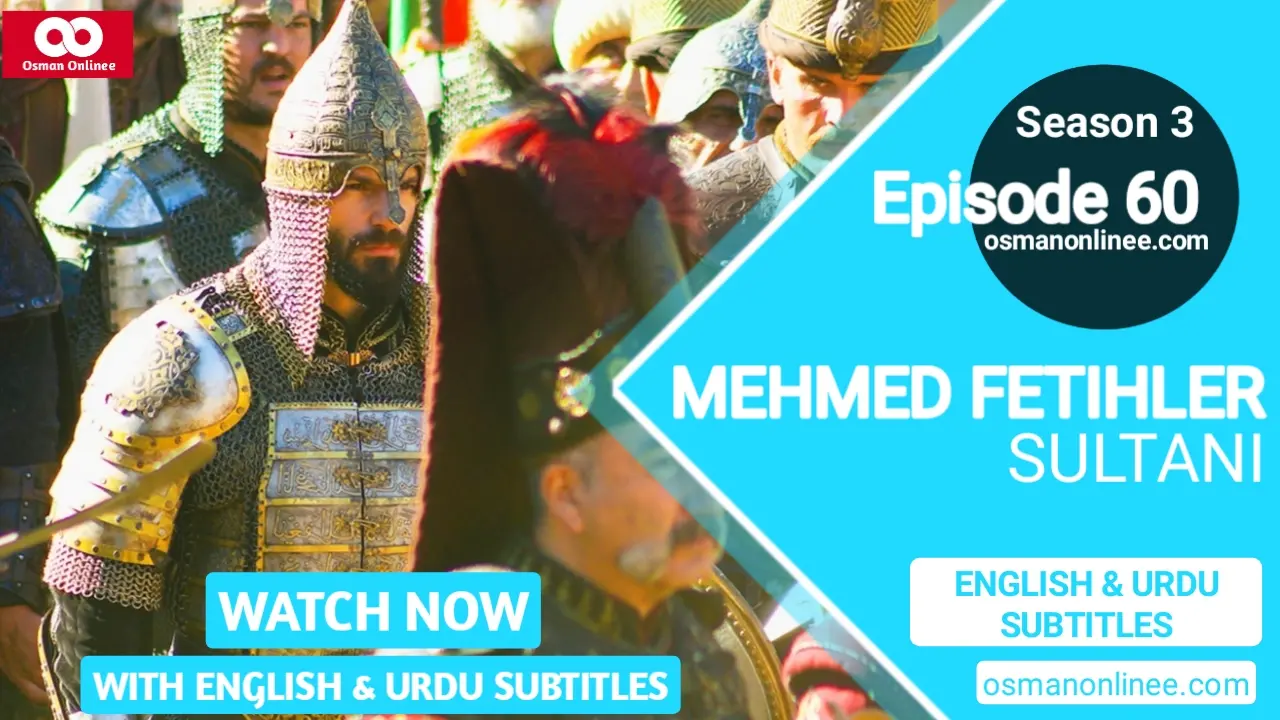
Mehmed Fetihler Sultani Season 3 Episode 60
Introduction
Mehmed Fetihler Sultani Season 3 Episode 60 marks a turning point in the Pontus campaign, delivering one of the most tension-filled and introspective episodes of the entire season. While the previous episodes emphasized strategic maneuvers and external combat, Episode 60 peels back the surface to reveal hidden motives, internal fractures, and the silent war unfolding within the Ottoman ranks. What makes this episode notable is how it transforms a seemingly ordinary stage of the siege into a battlefield shaped not only by swords but by secrets, suspicion, and psychological warfare.
Mehmed Fetihler Sultani Season 3 Episode 60
This episode explores the idea that every war has two fronts: the visible battlefield and the interior spaces where trust, fear, uncertainty, and ambition collide. Sultan Mehmed, standing at the center of these collisions, recognizes that the greatest danger is no longer the enemy behind the Pontus walls but the invisible cracks forming among his own men. Episode 60 uses these emotional and strategic complexities to craft a narrative that is far more layered than a simple siege.
Mehmed’s Evolving Leadership During the Pontus Siege
The Fire Behind Calm Eyes
Episode 60 opens with an atmosphere unusually quiet for a siege. The night before was heavy with losses and unanswered questions, and the dawn brings with it a sense of unease that spreads through the Ottoman camp like a cold mist. Soldiers prepare for another harsh day, yet their movements appear hesitant. It is in this subdued mood that Sultan Mehmed stands, calm yet alert.
The episode highlights Mehmed’s growing awareness that the conflict is no longer just external. Something within his ranks feels unsettled. The behaviors of certain commanders, the sudden disappearance of key scouts, and inconsistencies in reports all suggest an infiltrating threat.
But instead of responding with anger, Mehmed chooses contemplation. His leadership evolves from direct force to strategic silence. He studies his surroundings, observes each soldier carefully, and identifies the subtle gestures that reveal hidden truths.
Re-Examining the Siege Strategy
Unlike previous confrontations where Mehmed favored bold action, Episode 60 shows him reevaluating his approach. The Pontus campaign has entered a phase where every miscalculated move could lead to tragic consequences. The enemy has grown unpredictable, and the terrain itself has become a weapon.
Mehmed reassesses his commanders, reorganizes positions, and prepares for a psychological battle—not just a military one. This shift highlights his transformation into a leader who understands the importance of the mind in warfare.
Dark Currents Within the Ottoman Camp
Betrayal Reimagined
One of the strongest narrative elements of Episode 60 is its redefinition of betrayal. Instead of showing traitors simply as villains, the story explores betrayal as a product of fear, pressure, and unresolved history. Episode 60 emphasizes that betrayal often begins not with action but with hesitation, with a moment of moral cracking.
This conceptual shift creates deeper tension. Mehmed’s interrogations are not direct accusations but layered dialogues meant to uncover emotional motives.
A powerful line captures this theme:
“When loyalty wavers, even silence becomes a confession.”
Through this, the episode positions betrayal as an invisible threat with the power to collapse entire armies from within.
Vlad Tepeş: A Man Between Shadows
Vlad Tepeş plays a haunting role in Episode 60. His past as Mehmed’s childhood companion and later adversary gives every scene involving him emotional density. The episode shows him caught between buried rage and an unspoken desire for redemption. His eyes, body language, and hesitant answers create an atmosphere filled with uncertainty.
This ambiguity makes him one of the most intriguing figures of the episode. He becomes a mirror reflecting the psychological theme of Episode 60—trust that teeters between loyalty and betrayal.
The Silent Rift Among the Akıncılar
Meanwhile, the Ottoman akıncı forces face their darkest moment. The treacherous Pontus terrain, combined with the deadly traps set by Draven, leaves them physically weakened and mentally shaken. Slow, reflective sequences show akıncı warriors questioning their survival, their sense of purpose, and the devastating cost of the campaign.
These scenes highlight that war damages the spirit long before it harms the body.
Draven’s Evolution from Physical Traps to Mental Warfare
In previous episodes, Draven’s traps were lethal physical mechanisms intended to injure. But Episode 60 reveals a transition in his tactics. His traps now carry a psychological dimension—sounds echo across the valley at night, misleading tracks appear in the forest, and the Ottoman soldiers begin doubting their instincts.
Draven understands that when fear infects an army, even the bravest warrior becomes vulnerable.
Komnenos and the Art of Unpredictability
Komnenos brings another strategic layer. His sudden shifts between aggression and retreat make it nearly impossible for the Ottomans to predict his next move. He manipulates the tension within the Ottoman camp by feeding misinformation and exploiting the treacherous terrain.
These maneuvers transform the battlefield into a complex chessboard where one misread gesture can send entire battalions into chaos.
Şehzade Bayezid and Bali Bey: Two Paths Converging
Bayezid’s Growing Sense of Responsibility
Episode 60 continues Bayezid’s evolution from an inexperienced prince into a decisive figure. The pressure of the siege forces him to confront the reality that leadership is not about glory—it is about surviving the weight of impossible decisions. His conversations reflect maturity, and his actions reveal a developing strategic mind.
Bali Bey’s Steadfast Presence
As Bayezid navigates his emotional journey, Bali Bey emerges as his anchor. His guidance brings balance, wisdom, and discipline. He represents the values that have protected the empire for centuries: loyalty, patience, and clarity of purpose.
Their dynamic offers a refreshing contrast—youth seeking direction, and experience offering conviction.
I dedicate my time and effort to sharing Islamic history and the legacy of our heroes with the world. Your small donation helps me continue this mission. May Allah reward your support. 🤲
Mehmed Fetihler Sultani Season 3 Episode 60 With English And Urdu Subtitles
*
I dedicate my time and effort to sharing Islamic history and the legacy of our heroes with the world. Your small donation helps me continue this mission. May Allah reward your support. 🤲
A Table of Major Structural Developments in Episode 60
| Development | New Insight in Episode 60 | Impact |
|---|---|---|
| Internal betrayal | Emotional motives explored | Heightens camp tension |
| Vlad’s conflict | Ambiguous loyalty | Adds psychological suspense |
| Draven’s traps | Shift to mental warfare | Weakens soldier morale |
| Komnenos’ tactics | Unpredictable maneuvers | Forces strategic reevaluation |
| Bayezid–Bali Bey arc | Generational contrast | Strengthens narrative continuity |
| Mehmed’s leadership | Introspective & strategic | Builds toward a critical decision |
The Invisible Battlefield
When Silence Speaks Louder Than Swords
Episode 60 uses silence as a narrative device. Whether it’s soldiers staring into the night, Mehmed contemplating fate, or Vlad hesitating before answering a question, silence becomes the space where the true war unfolds.
Hope in the Midst of Chaos
Despite the grim reality, the episode uses moments of quiet hope to balance the darkness. Hope appears not as naive optimism but as a deliberate resistance against fear.
This emotional contrast gives Episode 60 philosophical weight.
List: New Elements That Distinguish Episode 60
- Psychological dissection of betrayal
- Deeper layers in Vlad’s character arc
- Draven’s transition to psychological tactics
- Komnenos’ unconventional warfare approach
- Bayezid’s rise into responsible leadership
- Enhanced introspective dimension of Mehmed
- Emphasis on silence and psychological tension
- More atmospheric portrayal of siege conditions
Cultural and Historical Insights
Psychological Warfare in Ottoman History
The Ottoman military often relied on observing enemy behavior, waiting for psychological fractures before engaging in full combat. Episode 60 mirrors this historical authenticity, depicting strategy as a patient craft.
Pontus as a Symbol of Resistance
Pontus has historically represented rebellion and territorial autonomy. Its siege symbolizes the struggle between imperial centralization and regional independence. Episode 60 uses this symbolism beautifully to enrich the narrative depth.
Key Takeaways
- Episode 60 shifts the war into psychological territory.
- Mehmed’s leadership becomes deeply introspective.
- Internal cracks become the biggest threat to the Ottoman campaign.
- Vlad’s emotional turmoil intensifies the suspense.
- Draven and Komnenos weaponize unpredictability.
- Bayezid continues his transformation into a future leader.
- The episode builds towards a decisive moment in the Pontus campaign.
FAQ
Is Episode 60 focused on large-scale battles?
No, it leans heavily toward strategy, psychological tension, and internal conflict.
Does Mehmed confront traitors in this episode?
He investigates but uses a subtler, psychological approach rather than direct confrontation.
Is Vlad Tepeş trustworthy in Episode 60?
His motives remain extremely ambiguous, adding suspense to the storyline.
Does the episode show major losses?
Losses occur indirectly through traps, exhaustion, and psychological strain.
Does the siege progress?
Yes, but in a strategic and mental sense rather than through direct conquest.
Conclusion
Mehmed Fetihler Sultani Season 3 Episode 60 is one of the season’s most intellectually charged episodes, shifting the emphasis from large-scale battle to introspection, psychological warfare, and unraveling loyalties. It presents the siege of Pontus not only as a physical conflict but as a deeply layered confrontation shaped by hidden fears, emotional fractures, and shifting alliances.
Through powerful character arcs, atmospheric tension, and strategic storytelling, Episode 60 prepares the audience for a monumental turning point in the campaign. It is an episode that proves war is fought not only with swords but with the heart, mind, and silent moments that define destiny.
- Mehmed Fetihler Sultani Season 3 Episode 61
- Mehmed Fetihler Sultani Season 3 Episode 60 With English Subtitles
- Kurulus Osman Season 6 Episode 187 With Urdu Subtitles
- Mehmed Fetihler Sultani Season 3 Episode 57 With English Subtitles
- Mehmed Fetihler Sultani Season 3 Episode 57 With English And Urdu Subtitles