
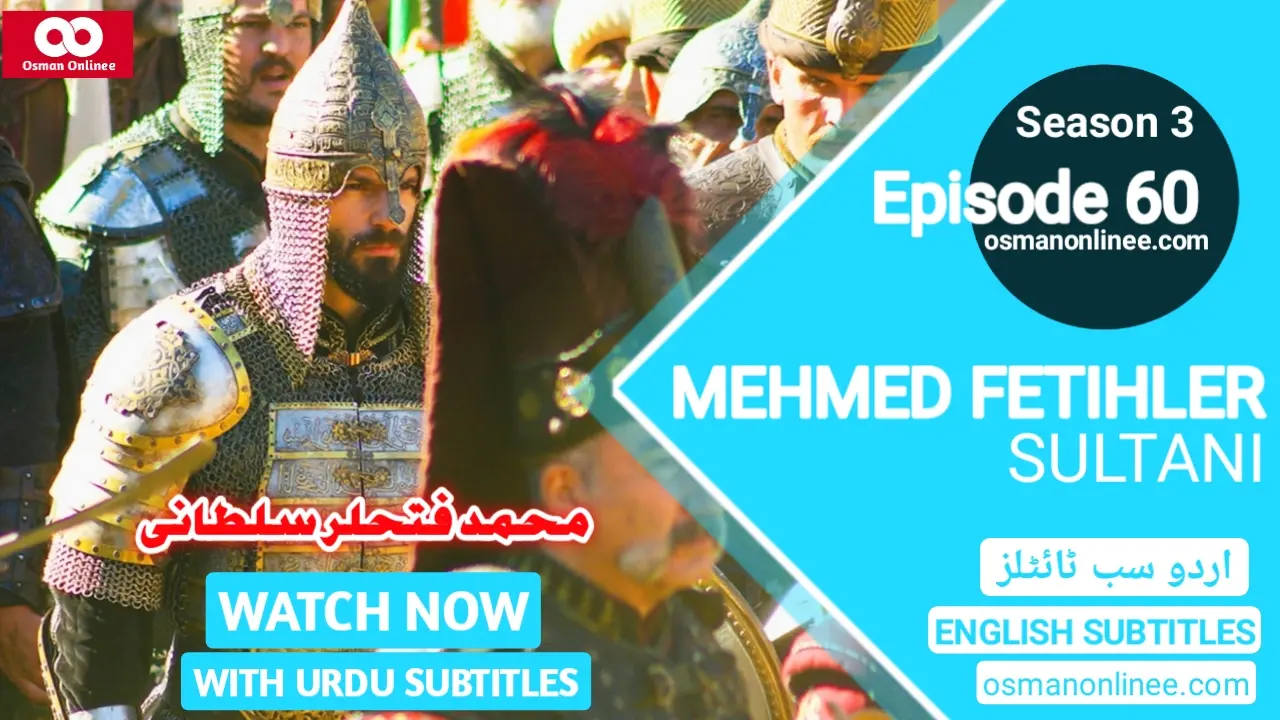
Mehmed Fetihler Sultani Season 3 Episode 60 With Urdu Subtitles
Introduction
Mehmed Fetihler Sultani Season 3 Episode 60 With Urdu Subtitles unfolds a turbulent new chapter in Sultan Mehmed’s long and demanding quest to tame the chaos of the Black Sea frontier. While the previous episode focused heavily on the siege of Pontus and the tangled network of betrayals creeping inside the Ottoman ranks, this new episode broadens the battlefield both physically and emotionally. The story moves beyond the visible siege lines and digs deep into political fractures, suppressed grudges, and hidden motives. With every passing moment, it becomes clear that the greatest danger to Mehmed’s campaign may not be the enemy behind the walls but the uncertainty within his own camp.
Mehmed Fetihler Sultani Season 3 Episode 60 With Urdu Subtitles
This episode builds upon the intense momentum established earlier but presents the events through a fresh lens—one that blends personal dilemmas with state-level decisions. Characters who once seemed predictable now reveal new layers, and alliances once considered solid begin to show cracks. Episode 61 carries a sense of transition: the kind of transitional storm that precedes decisive victory or catastrophic defeat. With Urdu subtitles, viewers gain access to a culturally enriched narrative that enhances their understanding of Mehmed’s moral burdens, strategic brilliance, and unyielding determination.
A New Phase in the Pontus Campaign
Shifting Tides Around the Fortress
Episode 61 begins at the break of dawn, capturing a landscape that is equal parts hope and despair. The Ottoman soldiers, worn yet resolute, brace for another day of conflict. The Pontus stronghold—surrounded but not subdued—remains the central threat. However, what sets this episode apart is its emphasis on the shifting tides around the siege. The walls of Pontus are no longer the only obstacles; the real challenge emerges from the unpredictable nature of human loyalty.
The previous battles have exposed vulnerabilities in both armies. For the Ottomans, the risk lies in the presence of traitors, spies, and individuals whose loyalty seems unstable. For Pontus, the pressure mounts as resources dwindle and unforeseen internal struggles come to light. Episode 61 capitalizes on this instability, following parallel narratives unfolding on both sides of the siege line. This technique gives viewers a panoramic view of the conflict and helps them understand how even small decisions can escalate into major turning points.
Mehmed’s Strategic Recalibration
Sultan Mehmed recognizes that the coming phase of the war cannot depend solely on brute force. Episode 61 gives us deeper insight into his diplomatic, psychological, and analytical methods. His approach becomes multi-layered—part military science, part political chess, part emotional endurance.
A striking detail is how Mehmed uses silence as a tool. Instead of issuing immediate orders, he often pauses, studies the mood of those around him, and interprets unspoken signals. It is through these subtle moments that he discerns hidden threats and reconfigures his strategy.
Internal Betrayals and Fractures in the Ottoman Camp
Suspicion, Loyalty, and the Weight of Leadership
One of the most compelling aspects of Episode 60 is its focus on internal fractures. A series of events from the previous episode triggered suspicion within the camp, and Episode 60 intensifies those tensions. Mehmed begins a fresh round of interrogations—not as mere punitive measures but as attempts to understand the psychology and motives behind each man.
The tone of these interrogations is different. Instead of rage, Mehmed adopts controlled intensity. He reads behaviors, listens for inconsistencies, and tests responses. His leadership style is dissected through these scenes, reminding viewers that empires are built on wisdom as much as on warfare.
Vlad Tepeş and the Shadow of Old Wounds
Vlad Tepeş continues to play a significant role in the psychological dimension of the storyline. His past sins and past alliances clash with his present stance, creating an air of unpredictability around him. Episode 60 explores his internal contradictions more deeply. Some scenes suggest genuine remorse; others hint at strategic manipulation.
“The past never dies—it hides in the cracks of a man’s heart until the right moment forces it out.”
This quote, delivered in a moment of layered symbolism, defines the emotional core of the episode.
A Silent Crisis Among the Akıncılar
Meanwhile, the akıncı forces face their own silent crisis. Their recent losses and the treacherous terrain of Pontus have taken a toll on morale. Episode 60 shows long, emotionally rich sequences of the akıncı warriors contemplating loyalty, sacrifice, and the value of their cause. These moments not only humanize the soldiers but also shed light on the socio-cultural structure of the Ottoman military.
The Wider Battlefield: New Dangers and New Alliances
Draven’s Mortal Traps and Komnenos’ Counterstrategies
As the episode progresses, the story shifts toward the frontline, where Draven’s deadly traps once again threaten Ottoman advancement. Episode 60 brings a new layer to these traps—not just physical but psychological. Draven uses terrain manipulation, misinformation, and symbolic messages to weaken Ottoman discipline. Komnenos, on the other hand, capitalizes on every small advantage, constantly adapting and evolving his counterstrategies.
The battlefield becomes a chessboard, where every move speaks of deeper motives. What appears to be a retreat may be bait; what seems like an attack might be a deception. These mind games create a larger narrative about warfare as an intellectual art rather than mere bloodshed.
Bali Bey, Şehzade Bayezid, and the Burden of Duty
Both Şehzade Bayezid and Bali Bey take center stage in this episode, representing two different shades of Ottoman responsibility. Bayezid, young yet determined, struggles to balance courage with caution. Bali Bey, seasoned and wise, understands the moral weight behind every order.
Their scenes together highlight the generational shift happening within the army. While Bayezid seeks to prove his worth, Bali Bey seeks to protect the integrity of the empire. Episode 61 positions their dynamic as a symbolic bridge between ambition and discipline.
A Table of Key Strategic Events in Episode 60
| Event | Description | Impact |
|---|---|---|
| Mehmed’s new interrogations | Revisits earlier betrayal suspicions | Realigns inner-circle loyalties |
| Vlad Tepeş’s emotional conflict | Past trauma resurfaces | Introduces unpredictable motives |
| Draven’s fresh traps | Combines deception + terrain | Slows Ottoman advance |
| Komnenos’ battlefield shifts | Sudden counterattacks | Forces Ottoman repositioning |
| Bayezid & Bali Bey discussions | Values, leadership, duty | Strengthens internal unity |
The Emotional Landscape of Episode 60
Fear as a Weapon
One of the episode’s strongest themes is the use of fear—not only by the enemy but also within the minds of the soldiers. Through prolonged silence, unexpected retreats, and sudden night disturbances, fear becomes a strategic force.
Hope as a Rebellion
Despite uncertainty, hope appears as an act of rebellion. Characters cling to promises, memories, and oaths. Mehmed’s leadership becomes the central force that transforms fragile hope into anchored determination.
List: Major Narrative Elements Introduced in Episode 60
- New layers of betrayal suspicion
- Deeper psychological portrait of Vlad Tepeş
- Tactical innovations by Draven
- Changing dynamics between Bayezid and Bali Bey
- Intensified mind-games by Komnenos
- Mehmed’s recalibrated leadership approach
Thematic Exploration
Honor, Sacrifice, and the Price of Empire
Episode 60 is fundamentally about the price of empire—what men must lose to protect what they love. The script delves into honor not as a simple virtue but as a burden carried silently.
War Beyond the Battlefield
The episode emphasizes that true war is fought not only with swords but with ideals, memories, and personal demons.
I dedicate my time and effort to sharing Islamic history and the legacy of our heroes with the world. Your small donation helps me continue this mission. May Allah reward your support. 🤲
💖 Don’t be shy, even $3 makes a difference and helps keep this work going! ❤️
Mehmed Fetihler Sultani Season 3 Episode 60 With Urdu Subtitles
SOURCE 1
Cultural Depth Through Urdu Subtitles
Watching the episode with Urdu subtitles adds cultural resonance. Ottoman expressions, idioms, and emotional cues become more understandable. Urdu’s poetic nature enhances dialogues, giving weight to Mehmed’s speeches and warrior laments.
SOURCE 2
Key Takeaways
- Episode 60 shifts focus from pure action to psychological warfare.
- Mehmed’s leadership evolves through patience, observation, and strategic silence.
- Vlad’s character becomes more unpredictable and layered.
- Draven and Komnenos introduce new multi-dimensional battlefield threats.
- Bayezid and Bali Bey’s dynamic symbolizes generational transformation.
- Internal fractures remain the biggest threat to Ottoman victory.
SOURCE 3
I dedicate my time and effort to sharing Islamic history and the legacy of our heroes with the world. Your small donation helps me continue this mission. May Allah reward your support. 🤲
💖 Don’t be shy, even $3 makes a difference and helps keep this work going! ❤️
FAQ
What is the central conflict in Episode 60?
The central conflict revolves around internal betrayal, psychological warfare, and the strategic intensity of the Pontus campaign.
Does this episode have major battle scenes?
Yes, but the main emphasis is on strategy, traps, and psychological manipulation rather than constant sword-to-sword combat.
Is Vlad Tepeş loyal to Mehmed in this episode?
His loyalty remains ambiguous. Episode 60 deepens his internal conflict and creates suspense around his future actions.
Why are Urdu subtitles important?
Urdu subtitles make the cultural nuances, idioms, and Ottoman expressions clearer for South Asian viewers, enhancing immersion and emotional depth.
Does Episode 60 set up the next major confrontation?
Absolutely. The shifting strategies and unresolved internal tensions pave the way for a dramatic escalation in the next episode.
Conclusion
Mehmed Fetihler Sultani Season 3 Episode 60 With Urdu Subtitles presents a richly layered narrative that goes beyond typical battlefield storytelling. It exposes the emotional, psychological, and political dimensions of empire-building. Through shifting alliances, silent threats, and decisive leadership, the episode creates a deep sense of anticipation for what lies ahead.
Episode 60 is not merely about the conquest of Pontus—it is about understanding the complexity of human loyalty and the cost of commanding an empire. With its unique blend of historical weight, character depth, and strategic brilliance, this episode stands out as one of the most intellectually engaging parts of the season.
- Mehmed Fetihler Sultani Season 3 Episode 60 With English Subtitles
- Selahaddin Eyyubi Season 2 Episode 53 With English Subtitles
- Mehmed Fetihler Sultani Season 2 Episode 48 With English Subtitles
- Mehmed Fetihler Sultani Season 3 Episode 59 With English Subtitles
- Mehmed Fetihler Sultani Season 3 Episode 57 With English Subtitles