
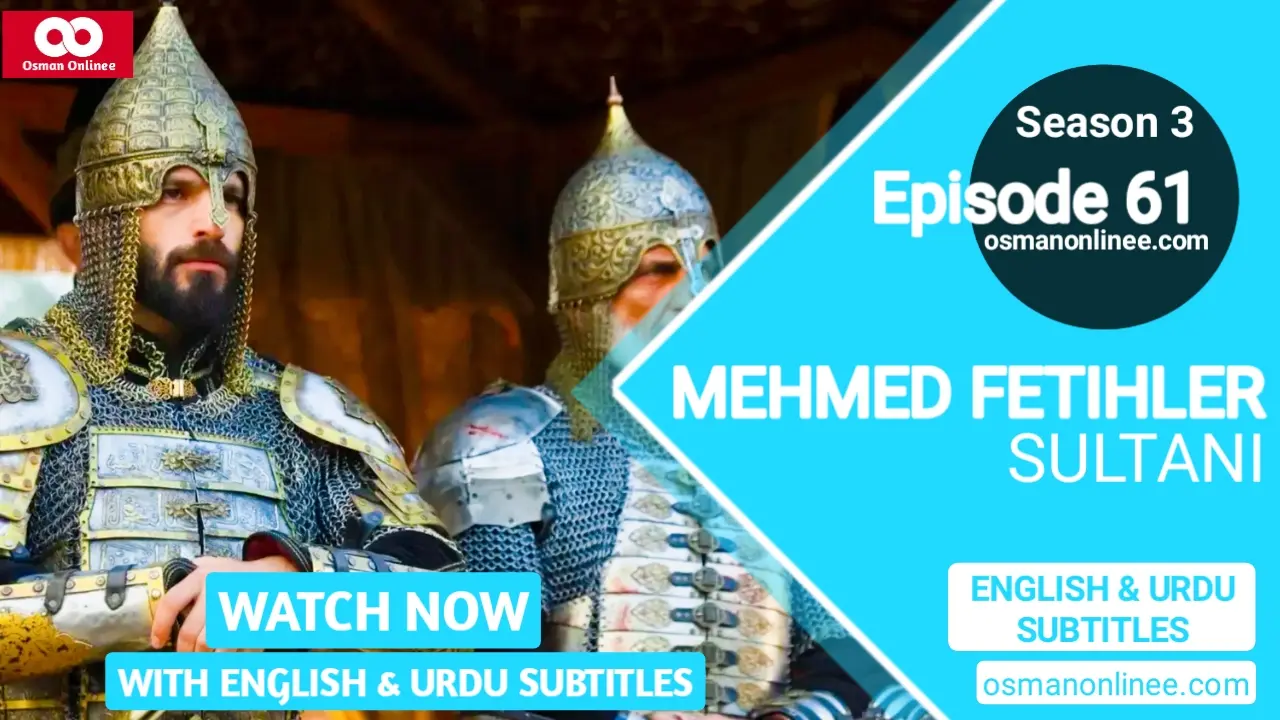
Mehmed Fetihler Sultani Season 3 Episode 61
Mehmed Fetihler Sultani Season 3 Episode 61
When a City Falls but the True Conflict Begins
Episode 61 of Mehmed Fetihler Sultani Season 3 is not structured as a celebration of conquest. Instead, it presents the fall of Pontus as a deeply complex transition where visible success masks invisible fractures. The episode deliberately slows its pace, allowing the audience to absorb not only what is happening, but what it means. Walls collapse, gates weaken, and control shifts hands, yet the emotional and political weight of these events lingers far beyond the battlefield. This is an episode about consequences rather than conclusions, where every step forward carries the echo of unresolved tension.
From the opening moments, the narrative establishes an atmosphere of unease. The city may be nearing its end, but certainty is absent. The closer Mehmed comes to victory, the more fragile trust becomes. Episode 61 frames conquest as a responsibility rather than a reward, placing leadership under scrutiny rather than praise.
The Breach That Exposed More Than Stone
The entry into Pontus begins through a weakened section of the outer defenses, a moment that initially suggests long-awaited progress. The forward units move swiftly, confident that resistance has thinned under prolonged pressure. Their presence inside the city symbolizes momentum, the belief that the final barrier has been crossed. Yet this optimism fades quickly as resistance emerges with unsettling precision. Movements are anticipated. Paths are blocked. Pressure appears exactly where it should not.
What makes this moment significant is not the resistance itself, but its timing. The opposing side does not react late or blindly. They respond as if informed. This realization quietly transforms the entire narrative. The breach in the walls becomes secondary to the breach in trust. The episode suggests that cities do not defend themselves intelligently without access to knowledge, and knowledge is never neutral.
This sequence establishes a central idea of Episode 61: information is more powerful than force. The forward units’ struggle becomes a symptom rather than a mistake, pointing toward a deeper issue that cannot be solved with speed alone.
Mehmed’s Evolution Under Pressure
When news reaches Mehmed, his response marks one of the episode’s most important character moments. There is no visible anger, no immediate reaction, no attempt to assign blame. Instead, Mehmed listens, processes, and reflects. This restraint is not hesitation; it is discipline developed through experience.
Information brought by Mustafa confirms what Mehmed already senses. The enemy’s preparation reflects an understanding of Ottoman strategy that goes beyond observation. This realization shifts Mehmed’s focus inward. The battlefield expands beyond Pontus and into the realm of loyalty, trust, and silence.
Rather than exposing suspicion, Mehmed chooses patience. He understands that accusation without certainty can damage unity more than betrayal itself. This moment reflects a ruler who has learned that leadership is not defined by how loudly one commands, but by how carefully one observes.
Vlad Tepeş and the Quiet Weight of Identity
As Mehmed’s awareness deepens, attention naturally gravitates toward Vlad Tepeş. The episode never presents this suspicion directly. Instead, it builds unease through atmosphere. Conversations lose warmth. Silences lengthen. Eye contact becomes brief.
The repeated mention of “Vlaciu” functions as a psychological reminder rather than an external threat. It represents an identity that Vlad has never fully left behind. Episode 61 treats this conflict with restraint, avoiding simplistic portrayals of loyalty or betrayal. Vlad is not shown as an enemy; he is shown as unresolved.
Bayezid’s discomfort reflects a broader uncertainty. He senses that something has shifted, even if he cannot articulate it. The episode suggests that unresolved identity can be more destabilizing than open opposition, because it introduces unpredictability rather than clarity.
Yorgo’s Promise and the Reality of Political Survival
Inside Pontus, Megaduke Yorgo faces his own reckoning. His secret promise to Mehmed is not framed as bravery or treachery, but as survival. He offers access in exchange for safety, a decision shaped by realism rather than principle.
The episode treats this choice without judgment, reflecting historical patterns where collapsing authority leads to pragmatic decisions. Loyalty becomes negotiable when power structures weaken. Yorgo’s offer introduces hope, but also delay, and delay is dangerous during moments of transition.
For Mehmed, the promise creates a dilemma. Trusting it could reduce loss. Waiting for it could cost momentum. Episode 61 allows this tension to remain unresolved, emphasizing that leadership rarely provides perfect choices, only calculated risks.
Draven’s Awareness and the End of Secrecy
Draven’s role in the episode highlights perception over action. He senses Yorgo’s intention without requiring confirmation. His awareness stems from understanding behavior under pressure, not from intelligence reports.
Yorgo’s sudden disappearance following an attack deepens uncertainty. The episode refuses to clarify whether the promise was fulfilled or silenced. This ambiguity mirrors Mehmed’s position. Trust dissolves not because it was broken openly, but because it could no longer be relied upon.
From this point forward, secrecy loses its value. Decisions shift from possibility to necessity.
The Long Silence Before the Final Move
As the promised time arrives, the episode slows dramatically. Mehmed’s camp waits. Attention fixes on the city gates. No signal appears. No movement follows.
This silence becomes one of the episode’s most powerful narrative tools. It strips away expectation and forces acceptance. Diplomacy has reached its limit, not through failure of intent, but through absence of certainty.
Mehmed understands that waiting any longer would create greater loss. Silence, in this moment, becomes an answer.
A Decision Rooted in Responsibility
Mehmed’s order to proceed is calm and final. There is no emotional display, no visible conflict. Preparation unfolds with discipline, reflecting authority grounded in control rather than urgency.
The advance is deliberate, reinforcing the idea that power does not rush when it is confident. Episode 61 presents this moment as the culmination of patience rather than reaction. Mehmed acts not because he desires force, but because delay has lost its purpose.
This decision defines his leadership in this episode. He neither hesitates nor overreaches. He moves because responsibility demands clarity.
Eren and the Power of Continuity
Amid large-scale movement, Eren’s moment provides emotional depth. Inspired by a vision connected to Ulubatlı Hasan, he pushes forward despite injury. His act is not framed as personal glory, but as continuity.
When he raises the banner, the gesture symbolizes responsibility passed from one generation to the next. The episode suggests that symbols often conclude conflicts where strategy alone cannot. Resistance fades not only because of force, but because meaning replaces fear.
The city accepts its fate not through defeat, but through recognition.
Vlad’s Departure and the Shadow of What Comes Next
The episode closes without celebration. After his final exchange with Mehmed, Vlad Tepeş leaves the camp alone. His words reveal a belief that Mehmed cannot abandon the conqueror within himself.
This moment redefines Vlad’s role. He is no longer simply a companion shaped by circumstance. He becomes a future uncertainty, carrying unresolved conflict forward.
Pontus is secured, but the narrative clearly signals that the greater struggle lies ahead.
I dedicate my time and effort to sharing Islamic history and the legacy of our heroes with the world. Your small donation helps me continue this mission. May Allah reward your support. 🤲
Mehmed Fetihler Sultani Season 3 Episode 61 With English And Urdu Subtitles
*
*
I dedicate my time and effort to sharing Islamic history and the legacy of our heroes with the world. Your small donation helps me continue this mission. May Allah reward your support. 🤲
Themes and Symbolism
Episode 61 weaves several themes together seamlessly: trust as a fragile structure, silence as communication, identity as a political force, and leadership defined by restraint rather than dominance. The banner represents continuity, the closed gates represent failed diplomacy, and Vlad’s departure represents unresolved consequence.
Key Takeaways
- The fall of Pontus exposes internal fractures
- Mehmed’s leadership matures through patience
- Vlad’s unresolved identity becomes central
- Symbols carry decisive influence
- Silence forces irreversible decisions
Conclusion
Mehmed Fetihler Sultani Season 3 Episode 61 presents conquest not as an ending, but as a transformation. While control is achieved, certainty is not. Trust weakens, identities resurface, and future conflicts quietly take shape.
This episode stands as a turning point where visible victory gives way to invisible consequence. It reminds viewers that history is shaped not only by strength, but by restraint, perception, and unresolved choices that follow success long after the gates have fallen.