
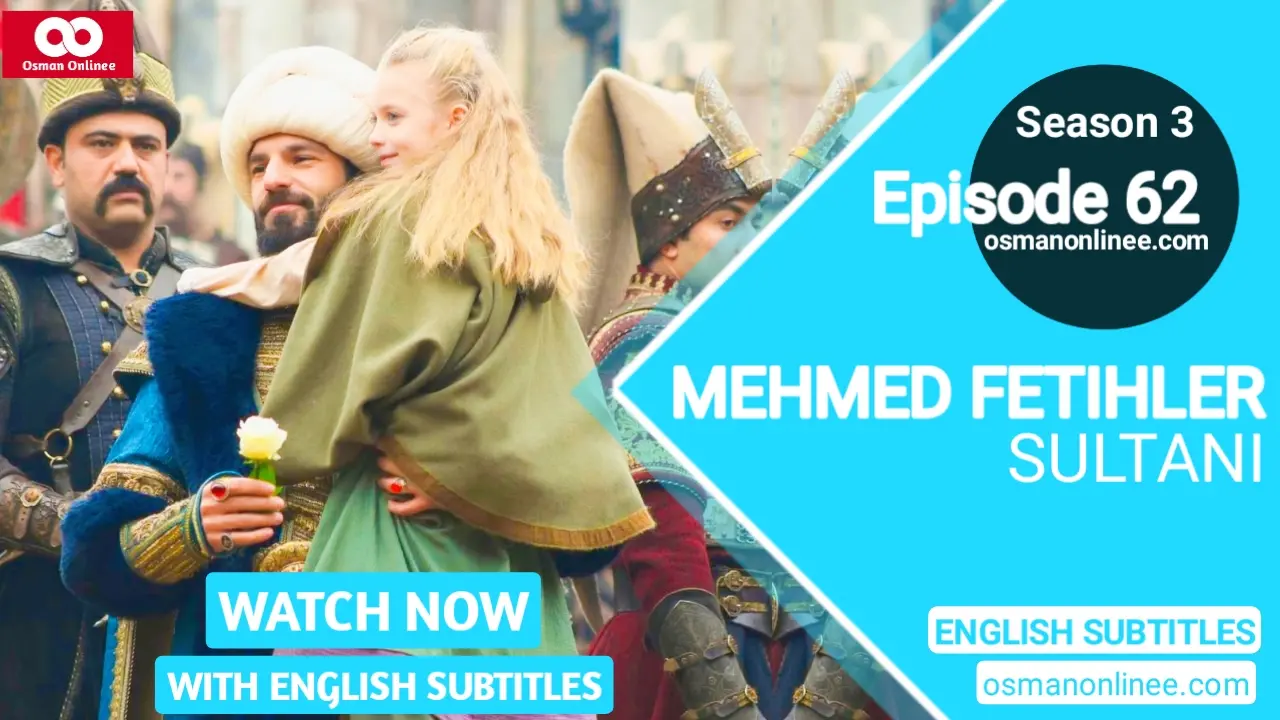
Mehmed Fetihler Sultani Season 3 Episode 62 With English Subtitles
Introduction: When Conquest Turns Inward
The narrative of Mehmed: Fetihler Sultanı Season 3 Episode 62 deliberately shifts the idea of conquest from mere territorial expansion to an internal reckoning of power, loyalty, and human ambition. Unlike earlier episodes that emphasized momentum and inevitability, this chapter slows the rhythm and forces the viewer to confront the uncomfortable reality that the most dangerous phase of any conquest begins after the gates are breached. The city is not portrayed as a defeated object but as a living, resisting entity—its streets echoing with fear, suspicion, and unresolved hatred.
This episode reframes victory as a fragile state rather than a final achievement. Stone walls may fall, banners may rise, but authority remains contested as long as human emotions remain volatile. By positioning betrayal, ambition, and personal vendettas alongside military strategy, the narrative challenges the simplistic notion that empires are built solely through force. Instead, it suggests that power survives only when it can discipline chaos from within.
From the opening moments, the storytelling signals a thematic evolution. The camera lingers not on wide battle formations but on narrow streets, locked doors, and exchanged glances. These details matter because they remind the audience that history is not shaped only by grand decisions but also by small, desperate choices made in moments of fear.
Historical Background: Why This City Matters
The Black Sea as an Imperial Lifeline
In Ottoman strategic thought, control of Black Sea gateways was not optional—it was existential. These ports determined trade dominance, naval security, and the empire’s ability to project power beyond Anatolia and Rumelia. Historically, Sultan Mehmed II understood that Constantinople alone was insufficient; without controlling surrounding maritime arteries, the capital would remain vulnerable to economic strangulation and foreign intervention.
Episode 62 subtly embeds this historical doctrine into its narrative. The city is framed not as an isolated objective but as part of a broader geopolitical web. Whoever controls this gateway influences grain supply routes, naval logistics, and diplomatic leverage across multiple regions. This context elevates the siege from a local conflict into a strategic necessity, explaining why the Ottomans are willing to endure prolonged resistance rather than retreat or negotiate prematurely.
Urban Warfare in the Medieval World
Urban combat during the fifteenth century was among the most lethal forms of warfare. Narrow streets erased numerical advantages, and familiar terrain favored defenders who knew every passage and rooftop. The episode accurately reflects this reality by depicting fragmented skirmishes rather than coordinated battlefield maneuvers.
Historically, many commanders underestimated cities after breaching their walls, only to suffer heavy losses inside. Episode 62 captures this mistake and corrects it narratively, emphasizing that conquest required not just strength but patience, intelligence, and ruthless discipline. The city becomes a maze where authority must be constantly asserted—or lost.
The Siege From Within: Storytelling Beyond Swords
When the City “Falls” but the War Begins
One of the episode’s most compelling narrative choices is its rejection of the false climax. The city is believed to be taken, yet the real conflict begins afterward. This reflects a harsh historical truth: many medieval cities collapsed not at the gates, but through internal fractures—hidden alliances, betrayal by elites, and delayed resistance.
The series uses alleyways, doors, and shadowed corridors as storytelling devices. Each narrow passage becomes a test of loyalty, where soldiers face not only armed enemies but moral uncertainty.
Sultan Mehmed: Character Analysis
Leadership at the Point of No Return
Sultan Mehmed’s decision to advance toward the heart of the conflict forms the moral and strategic axis of the episode. This is not an impulsive act of bravery, nor a theatrical gesture designed for legend. It is a calculated intervention rooted in Mehmed’s understanding of human psychology. At moments of uncertainty, symbols matter more than commands.
By placing himself within reach of danger, Mehmed collapses the distance between ruler and soldier. Historically, such acts carried immense risk, yet they also reinforced legitimacy in a way no decree could. The episode presents Mehmed as a ruler who understands that authority must be visible to be believed. His presence stabilizes chaos, even as it exposes him to it.
This moment also reflects Mehmed’s internal tension. He is both strategist and symbol, intellect and embodiment of state power. The closer he moves to the center of conflict, the narrower his margin for error becomes. Leadership here is shown not as privilege, but as isolation.
“A ruler who fears the battlefield invites rebellion long before defeat.”
This line resonates beyond the episode, encapsulating Mehmed’s governing philosophy: fear must be mastered publicly, or it will grow privately.
Secondary Figures: Princes, Pashas, and Personal Wars
The Princes: Legacy Versus Survival
The şehzades in this episode are not merely royal figures; they represent the future burden of empire. Their encounters in the streets expose them to the raw cost of power. The episode suggests that inheritance without hardship breeds fragile rulers.
Pashas and Commanders: Strategy Under Pressure
For the pashas, Episode 62 becomes a test of adaptability. Traditional battlefield hierarchies dissolve in urban chaos. Orders must be interpreted, not simply obeyed. This highlights a recurring theme: rigid authority collapses where flexible intelligence survives.
Themes and Symbolism
Loyalty Versus Ambition
At its core, Episode 62 is a study of divided loyalties. Soldiers fight under a single banner, yet personal ambitions fracture unity from within. Revenge, unresolved rivalries, and private calculations undermine collective purpose. The episode suggests that the greatest threat to empire is not the enemy at the gate, but the ambition concealed behind loyalty.
Historically, empires that expanded rapidly often struggled to integrate diverse interests. This tension is dramatized through characters whose personal wars quietly reshape the battlefield. Their actions delay consolidation and prolong violence, illustrating how ambition corrodes stability.
Light and Darkness as Moral Space
The visual language of the episode reinforces its moral ambiguity. Torchlight reveals faces only partially, while shadows dominate the city’s interior. No character exists entirely in the light. Decisions are made in uncertainty, and consequences remain unseen until they erupt into violence.
This symbolism reflects a broader truth about conquest: moral clarity is often sacrificed for survival. The episode refuses to offer simple heroes or villains, instead portraying power as a space where compromise and brutality coexist.
Fear as a Weapon
Fear functions as both a motivator and a destabilizer. It drives courage in some and betrayal in others. Episode 62 treats fear as an invisible force shaping outcomes more decisively than steel. Those who harness it gain control; those who deny it become its victims.
Cultural and Political Context
The Ottoman View of Conquest
Ottoman conquest ideology was never purely destructive. It combined military dominance with administrative integration. Episode 62 hints at this philosophy by showing that taking a city without securing loyalty leads to endless bloodshed.
Intrigue Beyond Borders
The mention of escape plans, distant alliances, and secret routes expands the narrative beyond the city itself. This reflects the interconnected medieval world, where diplomacy, espionage, and marriage alliances shaped outcomes as much as armies.
Unique Interpretation: Conquest as Self-Examination
Episode 62 can be read as an internal mirror for Sultan Mehmed himself. As he moves deeper into the city, he symbolically enters the most dangerous territory of all: absolute power. Every decision narrows the distance between visionary leadership and tyranny.
The episode quietly asks an uncomfortable question: Can an empire expand without losing its moral center?
I dedicate my time and effort to sharing Islamic history and the legacy of our heroes with the world. Your small donation helps me continue this mission. May Allah reward your support. 🤲
💖 Don’t be shy, even $3 makes a difference and helps keep this work going! ❤️
Mehmed Fetihler Sultani Season 3 Episode 62 With English Subtitles
SOURCE 1
Connection to Later Events and Predictions
The Cost of Centralized Authority
Mehmed’s personal involvement foreshadows a future where the sultan becomes the unchallenged axis of power. While effective, this also sets the stage for internal dependency—where the system struggles without a singular genius at its core.
SOURCE 2
Seeds of Future Betrayals
The unresolved intrigues and hidden alliances introduced here are unlikely to vanish. Historically, such fractures often resurfaced as revolts, palace conspiracies, or foreign-backed rebellions.
SOURCE 3
I dedicate my time and effort to sharing Islamic history and the legacy of our heroes with the world. Your small donation helps me continue this mission. May Allah reward your support. 🤲
💖 Don’t be shy, even $3 makes a difference and helps keep this work going! ❤️
Tactical Overview (Table)
| Element | Impact on Conquest |
|---|---|
| Urban Resistance | Neutralizes numerical advantage |
| Sultan’s Presence | Boosts morale, centralizes command |
| Internal Betrayal | Delays stabilization |
| Hidden Passages | Enables prolonged conflict |
Key Takeaways
- Conquest does not end at the gates; it begins inside.
- Leadership visibility can decide the fate of an empire.
- Internal divisions are more dangerous than external enemies.
- Power without trust creates endless resistance.
Conclusion: History Written in Narrow Streets
Mehmed Fetihler Sultani Season 3 Episode 62 With English Subtitles stands as one of the series’ most introspective chapters. It dismantles the illusion that conquest is a singular, triumphant moment and replaces it with a layered exploration of power, fear, and responsibility. By focusing on what happens after the walls fall, the episode confronts the audience with a harsher historical truth: victory without consolidation is merely delayed defeat.
Through Sultan Mehmed’s decisive yet isolating leadership, the narrative explores the burden of absolute authority. Every step toward control narrows the space for error, demanding not only strategic brilliance but moral endurance. But the city’s narrow streets become symbols of the constrained choices faced by those who rule.
Ultimately, Episode 62 reminds us that history is not shaped solely by conquest, but by what follows it. Empires are remembered not just for the cities they take, but for how they survive the chaos they unleash. In this episode, the Ottoman future is not merely secured—it is tested.
- Mehmed Fetihler Sultani Season 3 Episode 57 With English Subtitles
- Selahaddin Eyyubi Season 2 Episode 58 With English And Urdu Subtitles
- Watch Mehmed Fetihler Sultani Season 2 Episode 17 With English Subtitles
- Mehmed Fetihler Sultani Season 3 Episode 57 With English And Urdu Subtitles
- Mehmed Fetihler Sultani Season 2 Episode 44 With English Subtitles