
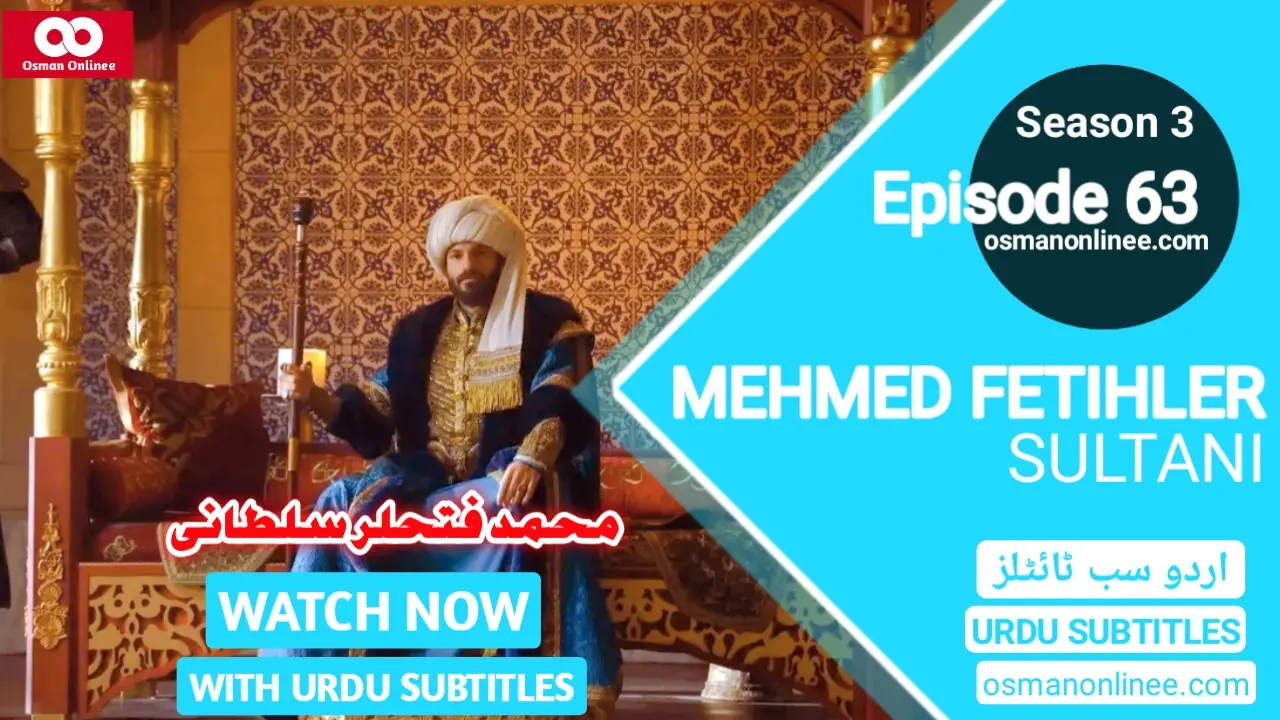
Mehmed Fetihler Sultani Season 3 Episode 63 With Urdu Subtitles
After the Swords Fall Silent: The Empire Faces Its Most Dangerous Phase
History often glorifies conquest, but civilizations are not built in moments of victory. They are built in the fragile silence that follows them. Once the city’s gates have fallen and the banners of a new ruler rise above its walls, the real struggle begins—not against armies, but against uncertainty, fear, memory, and ambition.
In this chapter of Mehmed Fetihler Sultani, the narrative moves decisively away from battlefield heroics and enters the realm of imperial psychology. The city has been taken, yet nothing feels settled. Streets remain tense, doors stay closed, and eyes watch from behind latticed windows. Victory has altered power, but it has not yet created belonging.
This is where Mehmed’s test truly begins.
Conquest Is an Event; Control Is a Process
One of the most important ideas shaping this phase is the understanding that conquest does not automatically produce authority. Armies can seize land, but they cannot command loyalty by force alone. The people of the city do not resist openly, yet they do not embrace their new rulers either. They exist in a state of suspended judgment, waiting to see what kind of rule will replace the old one.
Mehmed recognizes this pause as both an opportunity and a threat. If handled wisely, it can be transformed into acceptance. If mishandled, it will harden into long-term resistance. Therefore, his approach becomes measured rather than triumphant. Orders are precise. Discipline is enforced quietly. Violence is not celebrated, and chaos is not tolerated.
This restraint signals something profound: Mehmed is no longer acting like a conquering commander; he is thinking like a lawgiver.
The City as a Living Political Organism
The city itself emerges as a central character. It is not merely stone and streets but a living organism shaped by memory, trade, religion, and fear. Its population has survived different rulers before. They know that empires rise and fall, and that survival often depends on adaptability rather than loyalty.
Within its walls, former elites disappear into anonymity. Religious leaders test the limits of the new authority. Merchants calculate whether trade routes will remain open. Ordinary citizens wonder whether justice will be fair or arbitrary. Every group watches closely, because every early decision will define the nature of the new order.
Mehmed’s awareness of this dynamic prevents him from rushing to declare absolute control. Instead, he allows the city to reveal itself.
The Beys: Allies, Rivals, and Future Fault Lines
Victory alters relationships among the ruling elite more than it changes the fate of the defeated. Among the beys, unity forged during warfare begins to fracture under the weight of ambition. Some believe their contribution entitles them to privilege. Others see the conquered city as an opportunity for personal expansion rather than collective stability.
This internal tension is not accidental—it is inevitable. Empires do not collapse because of external enemies alone; they weaken when internal balance breaks. Mehmed’s leadership is defined by his response to this moment. He neither rewards loyalty blindly nor punishes ambition prematurely. Instead, he observes.
Those who maintain discipline, respect boundaries, and protect civilians quietly distinguish themselves. Those who exploit uncertainty expose their intentions. Authority begins to shift subtly, without announcement. Power is redistributed not through decree, but through access, trust, and responsibility.
Silent Justice and the Architecture of Authority
One of the most striking aspects of Mehmed’s strategy is his use of restrained justice. There are no public spectacles of punishment, no dramatic executions meant to intimidate. Instead, order is restored through systems—registrations, oversight, clear chains of command.
This approach carries deep historical significance. Empires that rely on fear remain unstable; those that rely on predictability endure. By prioritizing law over vengeance, Mehmed transforms authority from something personal into something institutional.
For the people of the city, this distinction matters. They may fear the conqueror, but they can coexist with the law.
Hidden Resistance and the Politics of Survival
Despite the appearance of calm, resistance does not vanish—it adapts. Secret passages, abandoned tunnels, and underground networks begin to activate. Some factions seek to escape with wealth or information. Others attempt to contact external powers, hoping to turn defeat into leverage.
Mehmed’s response to this threat is not brute force, but intelligence. Information becomes the most valuable weapon. The empire’s survival now depends not on swords, but on understanding intentions before they become actions.
This shift marks a transition from military leadership to statecraft. Power is no longer exercised through dominance, but through anticipation.
Religion, Culture, and the Question of Legitimacy
A conquered city’s soul resides in its sacred spaces. How a ruler treats these places defines his moral authority. Mehmed understands that destruction would only deepen hostility, while preservation combined with regulation creates legitimacy.
By respecting religious structures and cultural practices, he signals continuity rather than erasure. This choice reframes conquest as transformation rather than annihilation. Over time, such decisions reshape memory. The conqueror is no longer seen only as an invader, but as a ruler capable of restraint.
This cultural sensitivity is not weakness—it is strategic wisdom.
Symbolism: Silence as Power
One of the strongest symbolic themes in this chapter is silence. Mehmed does not declare grand victories. He does not issue sweeping proclamations. His authority manifests in calm, controlled presence. Where he stands, disorder fades.
Silence here represents confidence. A ruler who does not need to shout is one who knows his power is secure. This symbolism contrasts sharply with leaders who rely on spectacle to mask insecurity.
Seeds of Future Conflict
While order is established, tension remains. Beys remember moments of restraint. Ambitions that were denied do not disappear; they wait. The city appears stable, but beneath the surface, unresolved loyalties and suppressed resentments linger.
These seeds will shape future trials—rebellions, internal purges, political betrayals. The narrative subtly suggests that the greatest challenges to Mehmed’s rule will not come from defeated enemies, but from within his expanding empire.
Why This Phase Defines Mehmed’s Legacy
Great rulers are not remembered solely for what they conquered, but for what they built afterward. This chapter marks Mehmed’s transformation from a victorious commander into an imperial architect. His choices here determine whether his conquests become temporary triumphs or permanent foundations.
By prioritizing law, discipline, cultural respect, and internal balance, Mehmed positions himself as a ruler of systems rather than impulses.
I dedicate my time and effort to sharing Islamic history and the legacy of our heroes with the world. Your small donation helps me continue this mission. May Allah reward your support. 🤲
💖 Don’t be shy, even $3 makes a difference and helps keep this work going! ❤️
Mehmed Fetihler Sultani Season 3 Episode 63 With Urdu Subtitles
SOURCE 1
Connection to Future Imperial Developments
The administrative discipline established here will later enable expansion without collapse. The emphasis on intelligence over brute force will shape foreign policy. The careful management of elites will define court politics for years to come.
SOURCE 2
In this sense, the city is not merely a conquered territory—it is a blueprint.
SOURCE 3
I dedicate my time and effort to sharing Islamic history and the legacy of our heroes with the world. Your small donation helps me continue this mission. May Allah reward your support. 🤲
💖 Don’t be shy, even $3 makes a difference and helps keep this work going! ❤️
Conclusion
Mehmed Fetihler Sultani Season 3 Episode 63 With Urdu Subtitles presents one of the most intellectually rich phases of the narrative. It shifts focus from conquest to control, from heroism to governance, and from victory to responsibility. The city has fallen, but an empire is being born—slowly, deliberately, and with full awareness of the dangers that lie ahead.
This is not the story of a battle won.
It is the story of power learning how to endure.
Key Takeaways
- Conquest is temporary; governance defines permanence
- Internal unity is more fragile after victory than before
- Law creates stronger authority than fear
- Cultural respect strengthens legitimacy
- The greatest threats to empires often emerge from within
Frequently Asked Questions
Militarily, yes, but politically and psychologicall,y it has only evolved.
Because stability grows from predictability, not spectacle.
The transformation of power from force into structured authority.
- Mehmed Fetihler Sultani Season 3 Episode 62 With English Subtitles
- Mehmed Fetihler Sultani Season 3 Episode 62 With Urdu Subtitles
- Kurulus Orhan Season 1 Episode 3 With English Subtitles
- Mehmed Fetihler Sultani Season 3 Episode 57 With English And Urdu Subtitles
- Mehmed Fetihler Sultani Season 3 Episode 63 With English Subtitles